Introducing Father's Heart Bible™
Father’s Heart Bible™ in Divine Voice™ Color · Text Edition 2026.6
Father’s Heart Bible™ is a complete translation of the Bible, 66 books and 31,087 verses, from the original Hebrew, Aramaic and Greek. It is printed in Divine Voice™ Color: Father’s words in blue, Son’s words in red, and Spirit’s words in purple. Where other Bibles use “God” to say what He is, the Father’s Heart Bible™ uses “our Father” to show who He has been all along.
It is published in 25 audience editions, soon in 80 languages, free to read at fathersheartbible.com/read and on other Bible platforms worldwide through Digital Bible Library partners, and in print worldwide.
This overview sets out what we confess, how the translation was made, the texts behind it, how it names God, and how the Divine Voice™ Color is decided. All 160 translation rules are in the documents below.
What makes Father’s Heart Bible™ different
- A Father-first Bible. Father, Heart, Bible: its name is its order. It reveals our Father, His heart, and His gifts to us: His Son, His Holy Spirit and His written Word. Each reveals that our Father’s greatest gift is Himself, as Father.
- Receiving over reading. Our tag line reveals our Father’s heart: Receive the Father. Hear His Voice. His Heart is For You. It profits no one to carry a Bible and not know our Father.
- Our Father, named from Genesis 1:1. “In the beginning, our Heavenly Father created the heavens and the earth.” Where other Bibles use “God” and “Lord” to say what He is, Father’s Heart Bible™ says who He is.
- His voice in Divine Voice™ Color. The words of the Father (in blue), His Son (in red) and His Holy Spirit (in purple) are each printed in their own color, equipping and empowering readers to hear His voice.
- Written to carry our Father’s heart. Where the original allows it, the wording carries His personal warmth: His heart goes out to His people, He calls them His children, and the Bible is His story of restoring His beloved sons and daughters to Himself.
- Divine naming is mapped between the Old and New Testaments where Scripture provides it. Example: Isaiah saw “the Lord Jesus seated on a throne” (Isaiah 6:1), because John tells us Isaiah saw Jesus’ glory (John 12:41).
- Name and voice identified throughout. “Lord” stays with Jesus, apart from the exceptions shown in the names table. Our Father is identified as “Sovereign.”
- The speaker shapes the wording. In Genesis 3 the narrator speaks of “our Father,” but the serpent will only say “God”: “Did God really say…?” The Hebrew makes the same distinction, and Father’s Heart Bible lets every reader hear it. Those who keep Him at a distance call Him only “God”; His own call Him Father, nearly 7,000 times.
- A published method. Modern language technology, held to 160 written translation rules, applies each decision the same way across all 66 books, with a consistency and reach not available to earlier translations. Each book passed through successive faithfulness checks before release, and every rule is published in full.
The documents
Two documents, the same text as this page and more. Open one to read it in your browser, or download it.
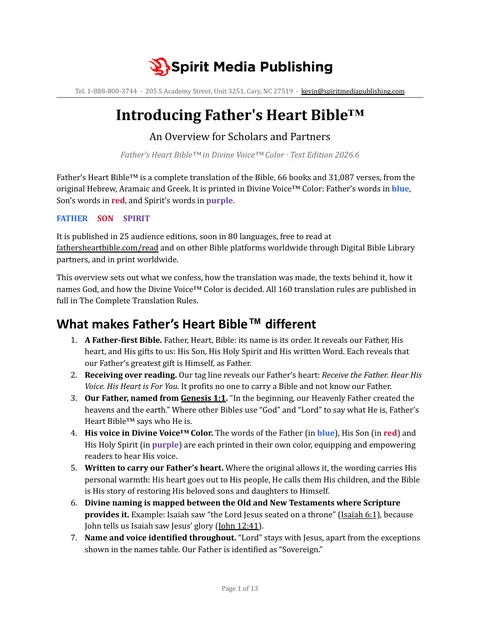
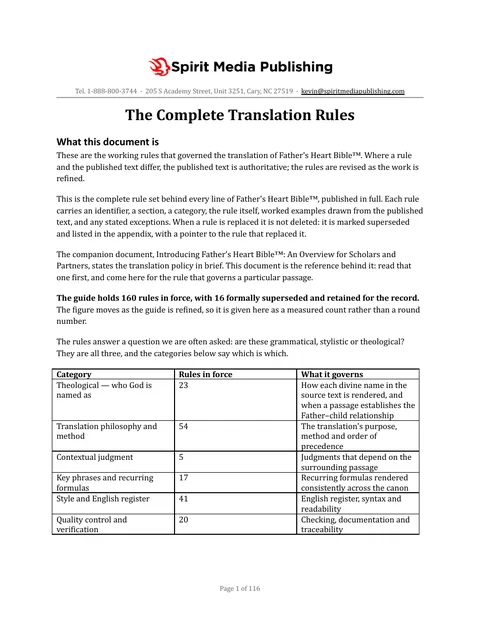
What we confess
- We believe in one God, eternally existing in three Persons: the Father, the Son and the Holy Spirit, each fully God, equal in glory and one in being.
- We believe that Jesus Christ is the eternal Son of our Father, fully God and fully man, who died for our sins, rose bodily from the dead, and is Lord of all.
- We believe that the Holy Spirit is a Person, not a force: He speaks, teaches, and gives life.
- We believe that we are restored to our Father by the blood of Jesus alone, by grace through faith, and not by our own works.
- We believe that the whole of Scripture, Old and New Testaments, is the inspired Word of God, and that nothing may be added to it or taken from it.
You can see it on the page
A translation shows what it believes where the text is most contested. These are the verses a scholar checks first, as Father’s Heart Bible™ prints them:
- John 1:1 — “In the beginning was the Word, and the Word was with our Father, and the Word was God.”
- John 8:58 — “Truly, truly, I say to you, before Abraham was, I AM.”
- John 20:28 — “My Lord and my God!”
- Romans 9:5 — “the Christ, who is God over all, blessed forever.”
- Colossians 2:9 — “For in him the whole fullness of deity lives in bodily form…”
- Titus 2:13 — “our great God and Savior, Jesus Christ…”
- Hebrews 1:8 — “But about the Son he says, ‘Your throne, O God, is forever and ever…’”
- Isaiah 6:3 — “Holy, holy, holy is our Father, Son, and Holy Spirit, the Lord of heaven’s armies.”
- Matthew 28:19 — “in the name of the Father and of the Son and of the Holy Spirit…”
- Acts 13:2 — “the Holy Spirit said, ‘Set apart for me Barnabas and Saul, for the work I’ve called them to.’”
- Ephesians 1:7 — “In him, through his blood, we have redemption—forgiveness of our sins…”
At Joel 2:32 our text reads “everyone who calls on the name of the Lord will be saved,” and the note there names Jesus, as Paul does in Romans 10:13.
How Father’s Heart Bible™ names God
The Hebrew and Greek Scriptures speak of God by many names and titles. Father’s Heart Bible™ renders each one by the Person it refers to, so the reader hears who is speaking and who is spoken of. Each source name follows one fixed rule, applied the same way through all 66 books. This table shows them side by side, so that anyone reading alongside another Bible can see where the wording differs and why.
Why “our Father”? Scripture speaks of one God, revealed in the New Testament as Father, Son and Holy Spirit, and the New Testament shows us which Person is meant. Jesus Himself names the God of Israel as His Father: “It is my Father who glorifies me, of whom you say, ‘He is our God’” (John 8:54). So where the New Testament identifies a passage with the Son or the Spirit, Father’s Heart Bible names the Son or the Spirit; everywhere else, the One who speaks and acts is our Father.
The New Testament names our Father as the source of creation and the Son as the one through whom it was made: “one God, our Father, all things from him … and one Lord Jesus Christ, all things through him” (1 Corinthians 8:6). So Genesis 1:1 reads “our Heavenly Father created the heavens and the earth,” 1:2 names “the Spirit of our Father,” and 1:26 keeps the plural: “Let us make humanity in our image…”
Where the New Testament sets God beside Christ, “God” names the Father, so Nathanael’s confession reads, “Rabbi, you are the Son of our Father!” (John 1:49). On the lips of those who do not know Him as Father, such as the tempter and the demons, the title stays “the Son of God” (Matthew 4:3), and in every place the title Son stands. Matthew’s “kingdom of heaven” is his reverent way of saying what Mark and Luke call the kingdom of God, and both are rendered as our Father’s kingdom: “Repent, for the kingdom of our Father is near” (Matthew 4:17).
Father’s Heart Bible never prints the divine name itself, the four Hebrew letters traditionally printed LORD, in its Bible text. Printed as four letters it says nothing to a modern reader, and a reconstructed pronunciation is a scholarly guess no congregation says aloud; and a Bible written to show that God reveals Himself as Father cannot render His own name as a word that says nothing about who He is. Where a note needs the name to explain a rendering, the note gives it.
| Hebrew or Greek | Usually printed elsewhere | Father’s Heart Bible™ | Example |
|---|---|---|---|
| YHWH (the divine name) | the LORD | our Father; from His own mouth, “I am your Father” to His people and “I am the Father” to the nations | Psalm 23:1 “My Father is my shepherd; I lack nothing.” · Exodus 20:2 “I am your Father, who brought you out of Egypt’s land” |
| Elohim / El (God) | God | our Father, where the Father is the one in view | Genesis 1:1 “In the beginning, our Heavenly Father created the heavens and the earth.” |
| Adonai (Lord, Master) of the Father | Lord | Sovereign | Genesis 15:2 “My Sovereign Father, what will you give me” |
| Adonai YHWH | the Lord GOD | the Sovereign Father | Isaiah 61:1 “The Spirit of the Sovereign Father is upon me” |
| YHWH Tzva’ot | the LORD of hosts | the Father of heaven’s armies | Haggai 1:2 “This is what the Father of heaven’s armies says” |
| El Shaddai | God Almighty | El Shaddai, your Father Almighty (Hebrew kept, meaning given) | Genesis 17:1 “I am El Shaddai—your Father Almighty.” |
| YHWH where the New Testament names Jesus | the LORD | Jesus, the Lord | Isaiah 6:5 “my eyes have seen the King, Jesus, the Lord of all heaven’s armies” (John 12:41) |
| All three Persons in view | the LORD | our Father, Son, and Holy Spirit | Isaiah 6:3 “Holy, holy, holy is our Father, Son, and Holy Spirit” |
| Theos (God) of the Father | God | our Father, or the Father | John 1:1 “the Word was with our Father, and the Word was God” |
| Theos where no single Person is meant | God | God (kept) | John 1:1 “the Word was God” · 1 Corinthians 8:6 “one God, our Father” |
| Kurios (Lord) of Jesus | Lord | Lord (kept for Jesus) | 1 Corinthians 8:6 “one Lord Jesus Christ” |
| Despotes (Master) of the Father | Lord, Master | Sovereign Father | Luke 2:29 “Sovereign Father, now you are letting your servant depart in peace” |
| YHWH, spoken by outsiders who do not know Him | the LORD | the LORD (kept, in 56 verses) | 1 Kings 5:7 Hiram: “The LORD be praised today” |
| God, spoken by someone who does not know Him as Father | God | God (kept) | Job 4:9 (Job’s friend) · Ecclesiastes 12:13 “fear God, keep his commands” |
| A passage where the speaker is genuinely uncertain | as the source | left open; no Person is supplied | Rule FHB-1.2-33 |
| “he” or “him” where the Person would be unclear | he / him | the name, Jesus or the Holy Spirit, where needed for clarity | Rules FHB-7.2 and FHB-7.3 (the only place a name stands where the source has a pronoun) |
Where another Bible prints a title, Father’s Heart Bible™ usually prints the Person. The Hebrew name has not been dropped; it has been read for who it names. Naming the Father also names the Son and the Holy Spirit beside Him, and the Divine Voice™ Color then shows which of them is speaking. Footnotes give the reason wherever a rendering rests on the New Testament’s own identification.
Every example verse above is quoted from the published text of Father’s Heart Bible™ at fathersheartbible.com/read.
Original data from the locked text: every name our Father is given, counted; who speaks in Scripture; the Bible by the numbers; a 365-day plan to read the Bible in a year.
How the Divine Voice™ Color is decided
Father’s Heart Bible™ prints the words of each divine person in that person’s own color: the Father in blue, the Son in red, the Holy Spirit in purple. Red-letter editions have done this for the Son since Louis Klopsch’s red-letter New Testament of 1899. We extend the same convention to the other two persons of the Trinity, and we apply one governing rule to all three. To our knowledge, Father’s Heart Bible™ is the first complete Bible printed with the words of the Father, the Son, and the Holy Spirit each in their own color.
The rule: the color marks words a divine person actually spoke. It is an ownership mark, not a quotation mark. The test is a single question asked of every span of text: Were these words actually spoken by a divine person?
It is never “who is holding the microphone,” and never “is the speaker righteous.” That one question settles most cases on its own. The principles below settle the rest, and each is applied consistently across the whole canon rather than verse by verse.
Our Father’s words, the Son’s and the Holy Spirit’s are counted book by book on who speaks in Scripture: how we count.
- Ownership travels. Words a divine person really spoke keep their color on whatever lips repeat them accurately: a prophet delivering them, a herald carrying them, an apostle quoting them. Paul quoting the Lord Jesus in Acts 20:35 carries the color: the words are still His.
- Containment — everything inside a divine utterance is His. Once a divine person begins to speak, every word until He finishes carries the color, including words He is quoting back from someone else. When our Father repeats the people’s own complaint in Ezekiel 33:17 and 33:20, or foretells what passersby will say in 1 Kings 9:8-9 and 2 Chronicles 7:21-22, those words are inside His utterance and are printed in His color. The test is containment, not proximity. A speaker’s own words elsewhere in the same verse stay black: Saul’s “Who are you, Lord?” in Acts 9:5 and Samuel’s “How can I go?” in 1 Samuel 16:2 sit outside the divine utterance, as does the narrator’s frame around it. This matches long-standing red-letter practice, which prints in red the Old Testament words Jesus quotes. Our red letter does the same, for example at Mark 7:6 and Matthew 4:7, and at the words He gives others inside His own sayings, as at Luke 12:19, Luke 15:19 and Matthew 25:12.
- Parables are never split. When the Son tells a parable, the whole parable is His speech, including the words He gives to characters inside it.
- Narration is never colored. The narrator’s frame, such as “Then our Father said,” is not itself divine speech and stays black. A formula such as “declares our Father” spoken inside His own words is part of His utterance and carries His color (principle 2).
- Words never spoken are never colored. Description of a divine person, address to Him, and report about Him are not His speech. Only what was said receives the color.
These are not private conventions. The governing rule and its corollaries are written into our translation rule set, published in The Complete Translation Rules, and every chapter is checked against them before publication.
Isaiah 5 and Isaiah 6: why “the Lord of Hosts” is not always the same Person
The title is rendered differently in these two chapters, and the difference is deliberate.
In Isaiah 5, “the Lord of Hosts” is rendered the Father of heaven’s armies (verses 7, 9 and 16). In Isaiah 6, the figure on the throne is rendered as the Son: verse 1 reads “I saw the Lord Jesus seated on a throne, high and lifted up,” and verse 5 “my eyes have seen the King, Jesus, the Lord of all heaven’s armies!”
The warrant is John 12:41. Having quoted Isaiah 6:10, John states why Isaiah spoke as he did. Our rendering reads: “Isaiah said these things because he saw Jesus’ glory and spoke about him.” Our note at that verse puts it plainly: when Isaiah saw the throne in the temple and the seraphim cried “Holy, holy, holy,” he was seeing the glory of Jesus.
The New Testament therefore identifies the occupant of the Isaiah 6 throne, and we follow that identification rather than overriding it. Where the New Testament makes no such identification, as in Isaiah 5, the title is rendered of the Father. The difference between the two chapters is not an inconsistency in our method; it is the result of applying it.
Father’s Heart Bible renders the threefold holy as “our Father, Son, and Holy Spirit” because all three Persons are in view in this vision. The New Testament tells us Isaiah saw the glory of Jesus (John 12:41) and that the Holy Spirit spoke through Isaiah (Acts 28:25), and in John’s vision of the throne the same threefold holy is sung to our Father: “Holy, holy, holy is the Sovereign Father Almighty” (Revelation 4:8).
The identification settles the color. Because the New Testament identifies the figure on the Isaiah 6 throne as the Son, the speech from that throne is printed in red, the Son’s color: “Whom should I send? Who will go for us?” in verse 8, and the commissioning oracle that follows in verses 9 through 13, from “Go, tell this people” to “The holy seed is its stump.” Verses 1 through 7 stay black, the seraphim’s threefold holy among them, because the color marks the words of a divine person and the seraphim are not divine persons.
The same words keep the same color wherever the New Testament carries them. Ownership travels, as principle 1 above states, so the oracle is red in Isaiah 6, and red again at John 12:40 and Acts 28:26-27 where it is quoted. Acts 28:25 names the agent: our rendering reads “The Holy Spirit spoke rightly to your ancestors through Isaiah the prophet.” The two statements stand together rather than competing. Our Lord Jesus is the one who speaks, and He speaks through the Holy Spirit; John 12:41 tells us whose glory Isaiah saw, and Acts 28:25 tells us how that word reached the prophet. One oracle, one owner, one color in all three places.
How it was made
On the familiar spectrum from word-for-word to thought-for-thought, Father’s Heart Bible™ is a meaning-based translation: it renders the original in clear, contemporary English, and it makes the Father’s identity, presence, and voice explicit where the text already carries them.
Where the Hebrew or Greek carries the family relationship, the English carries it too. “My people” may become “my children” where the passage speaks in family terms, of inheritance, covenant, discipline or planting, and stays “my people” where national identity is the point. A word may also be read at the depth of the whole story of Scripture, but only where a clear line can be traced from the source word; where it cannot, the standard word stays and the insight goes into a study note.
It is not a paraphrase, and it is not an adaptation of any existing English Bible. It is not a study Bible: its notes are written for general readers, and its method is documented for scholars in the companion documents. It is not abridged.
Father’s Heart Bible™ was produced through a structured, rule-governed translation process built for this work, bringing the consistency and reach of modern language technology to the ancient task of translation. Within that process, AI language tools rendered the text and footnotes directly from the original Hebrew, Aramaic, and Greek, guided by a written set of 160 translation rules.
The rules and every interpretive decision are the work of Spirit Media Publishing led by Kevin White, Editor.
On ordinary lexical and textual questions, our renderings agree with the settled consensus of the major modern translations and of the standard base texts, as most modern translations do. Our own contribution is focused and stated: how the Persons of the Trinity are named, and whose voice is speaking. The rules that govern both are published in full in The Complete Translation Rules.
The base texts
Father’s Heart Bible™ is translated from the original languages, not from an English predecessor. The Old Testament follows the Masoretic Text of the Leningrad Codex as printed in Biblia Hebraica Stuttgartensia, and the New Testament follows the modern critical text of Nestle-Aland 28 and the UBS fifth edition; our checks against the source are made with the Westminster Leningrad Codex, the digital edition of the same Hebrew manuscript, and the SBL Greek New Testament. The Aramaic portions (Daniel 2:4b–7:28, Ezra 4:8–6:18 and 7:12–26, and Jeremiah 10:11) are translated from the Aramaic.
Where the manuscripts differ, it keeps company with the consensus of the modern critical editions. Standard Hebrew and Greek reference works are gratefully acknowledged; the English text, notes, and headings are our own.
How the text was produced and checked
In practice, each chapter was translated whole, and the AI tools were never given an English translation as a source. They were required to cite the written rule behind every decision and to flag any decision no rule governs. They worked from their own command of the original-language text rather than from a supplied file of a printed edition, which is why the text is checked against the two editions named above.
That check against the source text has two parts, and we describe exactly what each covers. First, the verses in which “Father” appears two or more times are set beside the Westminster Leningrad Codex or the SBL Greek New Testament, so that each “Father” in them can be confirmed as the rendering of a divine name or title in the Hebrew or Greek; each flag is confirmed by reading the source before anything is changed. Second, a sample of revised verses is checked against the Hebrew and Greek, and no finding counts unless it cites the source word.
Consistency checks run on every chapter before it is published. They check every divine utterance against the rule and confirm that every edition carries its required statements.
Verse divisions follow modern English versification. The sixteen verse numbers listed under “Why are some verses missing?” below, which the modern critical editions do not print, are absent from the count.
How it was reviewed
Independent scholars in India, Nepal, the UK, the USA and other countries have reviewed the text, and every book passed through the review stages described above. Each edition carries a version number; this printing is Text Edition 2026.6. We never stop reviewing, and improvements are always welcome.
The language editions
Every language edition of Father’s Heart Bible™ is translated from the English Father’s Heart Bible™ with AI assistance, and every edition carries the same statement of provenance and translator credit, word for word in its own language.
Each edition now follows a written profile of the language’s own grammar and word order. The English gives the meaning; the language gives the form. A verb-final language keeps its verb at the end, a language that splits a quotation in two may do so, and the result is meant to read as that language is actually spoken, not as English with foreign words.
Each edition carries the whole Bible: 66 books and 1,189 chapters, with the footnotes, the book names and the reader interface in its own language. Each carries the Divine Voice™ Color: the words of the Father, the Son and the Holy Spirit marked to follow the English, so that a reader in any language hears who is speaking.
Before an edition is first published, it must pass the same set of checks: every chapter of every book present and complete; the Divine Voice™ Color matching the English, verse by verse; every quotation closed; the language’s own script rendered correctly throughout; the statement of provenance and the translator credit present. An edition that fails a check is not published until it is fixed.
The checks above prove the form of an edition. Native-speaker review is part of each edition’s ongoing care.
Father’s Heart Bible is being published in these 80 languages, chosen together to cover the world:
- Languages of India and South Asia: Bengali, Chokri Naga, Gujarati, Hindi, Inpui Naga, Kannada, Malayalam, Marathi, Nagamese, Nepali, Odia, Punjabi, Sindhi, Tamil, Tangkhul, Telugu, Urdu.
- East and Southeast Asia: Burmese, Cantonese, Cebuano, Chinese (Simplified), Chinese (Traditional), Filipino, Hiligaynon, Ilocano, Indonesian, Japanese, Javanese, Korean, Malay, Sundanese, Thai, Vietnamese.
- Africa: Afrikaans, Akan (Twi), Amharic, Anaang, Chichewa, Gikuyu, Hausa, Igbo, Izon, Kinyarwanda, Kipsigis, Kirundi, Kituba, Malagasy, Mangbetu, Nigerian Pidgin, Oromo, Sena, Shona, Somali, Swahili, Tigrinya, Xhosa, Yaka, Yoruba, Zulu.
- The Middle East and Central Asia: Arabic, Azerbaijani, Kurdish, Pashto, Persian, Turkish, Uzbek.
- Europe and the Americas: Dutch, English, French, German, Greek, Haitian Creole, Hungarian, Italian, Polish, Portuguese, Romanian, Russian, Spanish, Ukrainian.
Country guides for some of these languages: the Bible in Ukraine, Poland, Romania, Greece, Hungary, the Netherlands and South Africa. All countries are on the Bible around the world.
Read free at fathersheartbible.com/read
Questions scholars have asked
These are questions scholars and church leaders have asked us, with our answers. We add to this section as new questions come, so that every reader can see what others have asked.
Why Father's Heart Bible?
Not to replace any translation. What it adds is stated in How it was made, above: how the Persons of the Trinity are named, and whose voice is speaking.
Does Father’s Heart Bible simply put “Father” where other Bibles say “the LORD”?
Zephaniah 3:17 shows the method at work, word by word from the Hebrew.
“Your Father is in your midst, a mighty warrior who saves. He will rejoice over you with gladness; he will quiet you by his love; he will exult over you with loud singing.”
Hebrew — YHWH elohayik beqirbek, gibbor yoshia; yasis alayik besimchah, yacharish be’ahavato, yagil alayik berinnah.
| Hebrew | Literally | FHB | Where our wording comes from |
|---|---|---|---|
| יְהוָה אֱלֹהַיִךְ | YHWH your God | Your Father | Ours. This is the one rendering in the verse that is a decision of this translation, and it is the translation’s stated method, applied here, as wherever the divine name refers to the Father. |
| בְּקִרְבֵּךְ | in your midst | in your midst | The same as other English translations. Qereb is the inward part, the midst; “in your midst” is the literal rendering, and “with you” is the looser of the two options. |
| גִּבּוֹר יוֹשִׁיעַ | a warrior, he will save | a mighty warrior who saves | Warrior we share with other English translations, more than one of which reads “a warrior” too. Gibbor is a warrior — a man of strength in battle — and yoshia’ is the imperfect of yasha’, to save. “Warrior who saves” is the plain sense of the two words, which is why more than one translation arrives at it. Where we differ from some of them: the Hebrew has no article, so a mighty warrior, not the Mighty Warrior. |
| יָשִׂישׂ עָלַיִךְ בְּשִׂמְחָה | he will rejoice over you with gladness | he will rejoice over you with gladness | The same as other English translations. Three Hebrew words, each with an ordinary English equivalent: yasis (root śûś, to rejoice), ’alayik (over you), besimchah (with gladness). There is no third way to say it in plain English. |
| יַחֲרִישׁ בְּאַהֲבָתוֹ | he will be silent in his love | he will quiet you by his love | The same as some other English translations, and we judged that reading correct. Charash is to be silent or still; some take the silence as something He works in the one He loves, and that is the sense we also read in the Masoretic text. We note plainly that the more literal rendering of the Hebrew is “he will be silent in his love.” |
| יָגִיל עָלַיִךְ בְּרִנָּה | he will shout over you with a ringing cry | he will exult over you with loud singing | The same as other English translations. Gil is to exult or shout for joy; rinnah is a ringing cry, and in this context a song. |
The verse is a close rendering of five short Hebrew clauses, with the single rendering this translation exists to make: the naming of the One who speaks as our Father.
Where does the emphasis on “Father” come from?
See “Why our Father?” in How Father’s Heart Bible names God, above.
Is it aligned to a doctrinal system?
No. It is not aligned to Reformed, Arminian, dispensational or any other denominational system, and no rule is written to produce the distinctive of one. The theological rules govern how the divine Persons are named and how their words are marked, and they answer to the trinitarian confession, not to a school.
Is Father’s Heart Bible connected with the Jehovah’s Witnesses?
Because Father’s Heart Bible™ renders the divine names in its own way and speaks often of the Father, readers sometimes ask whether it is connected with the Jehovah’s Witnesses. It is not, in any way. The two translations stand on opposite sides of the verses above. Against Father’s Heart Bible™ readings already given, the Witnesses’ New World Translation (2013 revision) reads:
- John 1:1 — “the Word was a god.”
- John 8:58 — “before Abraham came into existence, I have been.”
- Colossians 1:16 — not quoted above — “by means of him all other things were created.” The word “other” is not in the Greek. Father’s Heart Bible™: “everything was created in him.”
- Titus 2:13 — “the great God and of our Savior, Jesus Christ,” read as two persons.
- Hebrews 1:8 — “God is your throne forever and ever.”
- Genesis 1:2 — not quoted above — “God’s active force.” Father’s Heart Bible™: “the Spirit of our Father.”
The difference runs through the divine name as well. The New World Translation prints “Jehovah” thousands of times, including in the New Testament, where no Greek manuscript has the divine name. Father’s Heart Bible™ renders YHWH by the Person it refers to, and where the New Testament identifies that Person as Jesus, it names Jesus.
Both speak of the Father, but for opposite reasons. The New World Translation exalts the Father in a way that makes the Son less than God. Father’s Heart Bible™ names the Father in order to reveal the Son and the Holy Spirit beside Him, one God in three Persons.
The Scriptures reveal a Father who restores His children to Himself through the blood of His own Son (Ephesians 1:7). No one comes to the Father except through Jesus (John 14:6). That is the faith Father’s Heart Bible™ was made to proclaim: not a new revelation, not a new prophet, not salvation by works, but the Father, the Son and the Holy Spirit, and the blood of Jesus.
Why are some verses missing?
Because it follows the modern critical text, sixteen verses found in the Textus Receptus tradition are not present as numbered verses:
Matthew 17:21 · Matthew 18:11 · Matthew 23:14 · Mark 7:16 · Mark 9:44 · Mark 9:46 · Mark 11:26 · Mark 15:28 · Luke 17:36 · Luke 23:17 · John 5:4 · Acts 8:37 · Acts 15:34 · Acts 24:7 · Acts 28:29 · Romans 16:24
Matthew 12:47, Matthew 21:44, and Luke 22:43-44, sometimes grouped with that list, are present.
Does the Holy Spirit speak in the Bible?
Yes. “The Holy Spirit said, ‘Set apart for me Barnabas and Saul…’” (Acts 13:2). The Spirit speaks to Philip (Acts 8:29), to Peter (Acts 10:19-20), and through Agabus (Acts 21:11), in Revelation He answers from heaven (Revelation 14:13) and calls with the Bride (Revelation 22:17), and in our hearts He cries, “Abba, Father!” (Galatians 4:6). Because the Spirit’s own recorded words are few, His color appears rarely: in ten verses of the whole Bible.
Why “Sovereign”?
It renders the Hebrew Adonai, or the Greek Despotes. Because the translation keeps “Lord” for Jesus, the Father’s Adonai needs a word of its own, and “Sovereign” is the word the New Testament itself uses of the Father (Luke 2:29, Acts 4:24, Revelation 6:10). The compound title YHWH Tzva’ot, which carries no Adonai, reads “the Father of heaven’s armies.” It follows the Hebrew word, not a theological school.
How are disputed passages such as Mark 16:9–20 handled?
Four passages whose manuscript support is debated are printed, each with a note that states the position plainly:
- Mark 16:9-20: The earliest manuscripts end Mark at verse 8. Verses 9-20 are found in most later copies and are printed here, as in most modern Bibles.
- John 7:53-8:11: This account is not in the earliest manuscripts of John, and later copies place it at several different points. It is printed here, where the tradition settled, as in most modern Bibles.
- Luke 22:43-44: Verses 43-44 are absent from some early manuscripts. They are printed here, as in most modern Bibles.
- 1 John 5:7: printed in its critical-text form, with the note: Some late copies expand this verse to name the Father, the Word, and the Holy Spirit in heaven. Those words appear in no early Greek manuscript and are not part of what John wrote.
Who appeared to Abraham, Jacob and Moses?
In the Old Testament appearances, at Mamre, at Peniel and at the burning bush, Father’s Heart Bible names the One who appears as our Father, following the identification made from Genesis 1:1: “Now our Father appeared to Abraham at the oaks of Mamre” (Genesis 18:1). Where the New Testament identifies an appearance as the Son, the New Testament governs, as in Isaiah 6 (above). Many in the church since its earliest days have read these appearances as the Son before He became man, and that reading has a long and serious history.
Who is on the throne in Ezekiel 1 and Revelation 4?
Here too the identification is made on New Testament grounds, and in the opposite direction.
At Revelation 4:2 our note states that the one on the throne is our Father, and gives the reason: at Revelation 5:7 the Lamb takes the scroll from the right hand of the one seated on the throne, so the Father and the Son are plainly distinct in that scene. The note also records that by Revelation 22:1 they share the throne.
Ezekiel 1:26 is the harder case, and the text itself supplies the answer. In 1:26-28 Ezekiel does not describe God directly. He writes of “the likeness of a throne” and, above it, “a likeness with the appearance of a human” — and he closes at verse 28 with what the Hebrew calls “the glory of YHWH” (our rendering: “So looked the likeness of our Father’s glory”). What is attributed to the Father is the glory, not a human body. Ezekiel’s piled-up language of likeness and appearance is precisely his way of keeping the vision at one remove from the One it reveals, and our rendering preserves that distance rather than collapsing it.
Each throne is identified by what Scripture itself says about it.
Available in print worldwide
Each audience edition is the complete Father’s Heart Bible in Divine Voice™ Color, with opening pages written for one group of readers, such as athletes, nurses, pastors or children in foster care.
Father’s Heart Bible™ is available in print through retailers worldwide. See every edition at fathersheartbible.com/print and every ISBN at fathersheartbible.com/isbn.
Bible societies and publishers are welcome to license Father’s Heart Bible™ for print in their own country or language.
Copyright and notices
Holy Bible, Father’s Heart Bible™, copyright © 2026 by Spirit Media Publishing, the imprint of Spirit Media Inc. All rights reserved. Father’s Heart Bible™ · Text Edition 2026.6. Translator: Spirit Media Publishing. Editor: Kevin White.
The permissions to quote, the required credit lines and the trademarks are set out on Copyright & Permissions.
Spirit Media Publishing, the imprint of Spirit Media Inc. · 205 S Academy Street, Unit 3251, Cary, NC 27519 · 1-888-800-3744